An interview on the mono-monostatic tetrahedron, widely known as “Bille”, has recently appeared with one of its inventors, member of our research group, Gergő Almádi. The interview is available online clicking here.
Institutional Scientific Students’ Associations Conference 2025
At this year’s Institutional Scientific Students’ Associations Conference at the Budapest University of Technology and Economics, five presentations were related to the HUN-REN Research Group of Morphodynamics:
1st Prize, Pro Progressio special award and Dénes Gábor Scholarship
The Soft Cube
Kinga Kocsis
supervisor: Gábor Domokos and Ákos G. Horváth
2nd Prize
Optimization of kirigami arcs
Zsófia Mária Gyetvai
supervisor: Eszter Fehér
Special award of the Department of Mechanics, Materials and Structures
Design of pasta bridges or moment relief of structural system using tension systems
Lenke Sára Marozsi
supervisor: Ágoston Szesztay
Special award of the Department of Morphology and Geometric Modeling
Analysis of the spatial shape of snail shells
Réka Viktória Csende
supervisor: András Sipos
and
Geometric and mechanical analysis of elliptical shell structures based on examples constructed in Hungary
Emília Schmera
supervisor: Máté Szondi
1st Prize in the session of Mathematics
Chaos in Large Language Models
Gregorio Jaca Jr
supervisor: János Török and Kristóf Benedek
Congratulations!
BME Rector’s award for Gergő Almádi and Gábor Domokos
Gergő Almádi and Gábor Domokos, members of the HUN-REN Morphodynamics Research Group, has been recognized by the Rector’s Award of Budapest University of Technology and Economics for describing the first mono-monostatic tetarahedron named “Bille”.
The existence of such tetrahedron was conjectured by J.H. Conway in 1984, and that conjecture is proved by the construction of Bille, described in the MSc Diploma thesis of Gergő Almádi.
Congratulations!
Morphodynamics in the National Museum of Hungary
Young researchers of our research group introduced new scientific results to the public on 11th October in the framework of the exhibition “Varázshatalom” (“Magic Power”) organized upon the 200th anniversary of the foundation of the Hungarian Academy of Sciences.
Kinga Kocsis and Gergő Almádi presented mono-monostatic inhomogeneous solids, including “Bille”, the first existing construction for the mono-monostatic tetrahedron.
National Scientific Students’ Associations Conference 2025
Several presentations were held in the session for Physics, Geosciences and Mathematics, Applied Geometry of the 37th National Scientific Students’ Associations Conference in relation with the Morphodynamics Research Group as follows:
- Gergő Almádi: Swindlers’ guide: the complex ways of loading dice, 1st prize (supervisor: Gábor Domokos)
- Gergő Almádi, Eszter Ferencz: The time evolution of crack networks, or, the Gilbert-piaffe, special prize (supervisor: Gábor Domokos, Ferenc Kun)
- Eszter Ferencz: Aptychusok szerkezetének geometriai elemzése, special prize (supervisor: Gábor Domokos)
- Kinga Kocsis: Ezer tonna márvány, avagy tér-idő utazás Michelangelo kőtömbjeihez (supervisor: Gábor Domokos)
- Kinga Kocsis: Ideal wall mosaics (supervisor: Gábor Domokos)
In the section of Engineering Sciences:
- Máté Szondi: Alakevolúciós egyenlet használata membránfelületek számítására (supervisor: András Sipos)
In addition, the above work of Eszter Ferencz on aptychi was awarded by a third prize on the XXVI. Transylvanian Scientific Student’s Association Conference in the section of Civil engineering and Architecture.
Congratulations!
Gyula Farkas Memorial Award for Krisztina Regős
The János Bolyai Mathematical Society decided on the Gyula Farkas Memorial Awards: one of the awardees in 2025 is Krisztina Regős, PhD student of the HUN-REN Morphodynamics Research Group.
Congratulations!
New paper and an interview on planetary surface mosaics
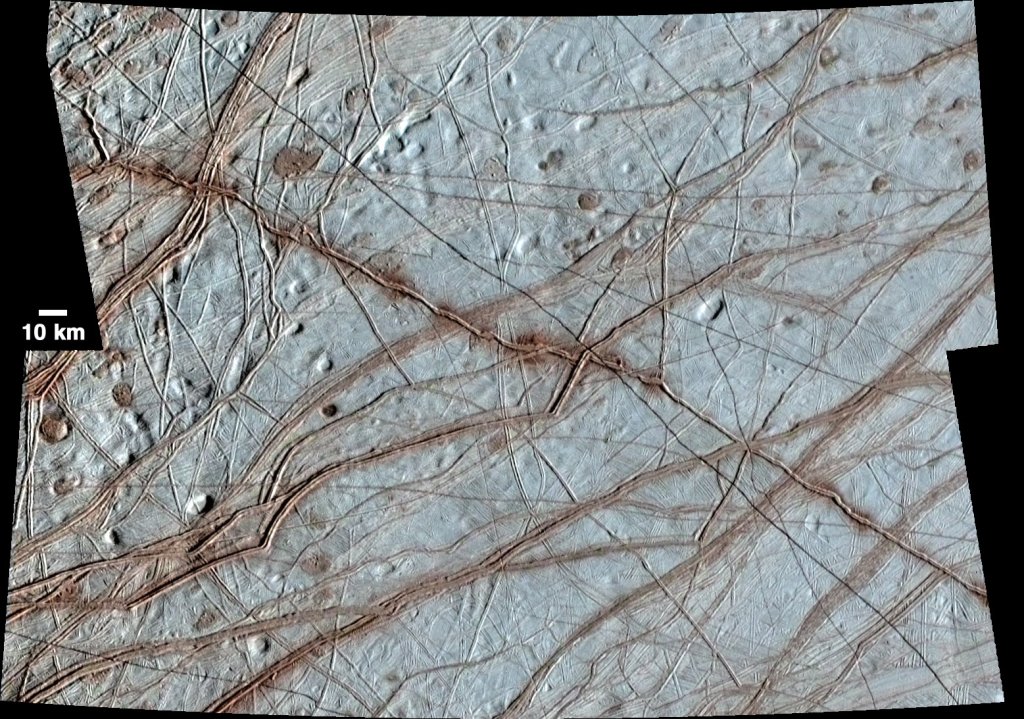
Decoding planetary surfaces by counting cracks
Sophie Silver, Douglas Jerolmack, Krisztina Regős, Gábor Domokos.
Abstract: Planets are often covered with thin cracked shells. From mud films to lithospheres of rock or ice, fracture networks form two-dimensional (2D) tessellations of convex polygons whose geometry encodes their genesis. Here, we chart the geometry of 2D fracture mosaics across the solar system, and decode their formative conditions using a new dynamical crack model. We show that mosaics can be projected onto a Symbolic Ternary Diagram, where the relative proportions of “T,” “X,” and “Y” junctions are uniquely related to contributions from distinct modes of fracture. Most planetary mosaics cluster in a region associated with hierarchical fracture networks, where sequential cracking favors formation of T junctions. Exceptions to this rule may betray the presence of water. Europa’s fracture networks stand apart due to the predominance of X junctions; this is a special feature of ice, where healing of cracks by refreezing of water allows new fractures to overprint older ones. Several fracture networks on Mars appear as outliers due to the high proportion of Y junctions. These patterns—previously interpreted as ancient mudcracks and frozen polar terrain, based on geological evidence—are consistent with the twisting of crack junctions by cyclic volume change. Our findings suggest that counting cracks could aid in the identification of other water-influenced planetary environments.
(See also the related interview at the website of BME.)

Field trip and international workshop in Spain
A group of researchers and students from the HUN-REN Morphodynamics Research Group made a visit to the Univerity of Vigo and Cedex, Madrid between 2-7 March. In addition to a field trip to rocking stones, the group participated in an international workshop on rock mechanics and geometry, hosted by the Cedex. 
Institutional Scientific Students’ Associations Conference 2024
This year’s Institutional Scientific Students’ Associations Conference at the Budapest University of Technology and Economics was notably successful for the HUN-REN Research Group of Morphodynamics: four students of the group were among the winners of different prizes:
Continue Reading “Institutional Scientific Students’ Associations Conference 2024”
Lectures for high school students
A series of scientific informative lectures for interested high school students has been organized by the HUN-REN Morphodynamics Research Group.
- Kocsis Kinga: Ezer tonna márvány, avagy tér-idő utazás Michelangelo kőtömbjeihez (A thousand ton of marble or a time-space travel to the stones of Michelangelo)
- Szondi Máté: Alakevolúciós egyenlet használata membránfelületek számítására (Application of shape evolution equations for calculating membrane surfaces)
- Regős Krisztina: A diszkrét Gömböc nyomában (In the wake of a discrete Gömböc)
(Lovassy László High School, Veszprém, 8 December, 2023)
- Almádi Gergő: Tetraéderek egyensúlyairól (On equilibria of tetrahedra)
- Nagy Klaudia: Falak geometriája (The geometry of walls)
- Regős Krisztina: A diszkrét Gömböc nyomában (In the wake of a discrete Gömböc)
(Deák Ferenc High School, Budapest, 23 January, 2024) Link
- Regős Krisztina: A diszkrét Gömböc nyomában (In the wake of a discrete Gömböc)
- Ferencz Eszter: Repedéshálózatok időfejlődése, avagy a Gilbert-piaffe (Time evolution of crack networks or the Gilbert piaffe)
- Kocsis Kinga: Ezer tonna márvány, avagy tér-idő utazás Michelangelo kőtömbjeihez (A thousand ton of marble or a time-space travel to the stones of Michelangelo)
(Árpád High School, Budapest, 27 March, 2024)
- Almádi Gergő – Regős Krisztina: A diszkrét Gömböc nyomában (In the wake of a discrete Gömböc)
(Teleki Blanka High School, Budapest, 23 April, 2024)
- Domokos Gábor: A láthatatlan kocka (The invisible cube)
(Teleki Blanka High School, Székesfehérvár, 20 June, 2024)
- Domokos Gábor: Kemény sziklák és lágy cellák (Hard rocks and soft cells)
- Almádi Gergő: Repedéshálózatok időfejlődése, avagy a Gilbert-piaffe (Time evolution of crack networks or the Gilbert piaffe)
- Regős Krisztina: A diszkrét Gömböc nyomában (In the wake of a discrete Gömböc)
- Szondi Máté: Adhat-e ötletet a természetes kopás a héjszerkezetek tervzéséhez? (Can natural abrasion inspire the design of membrane structures?)
(Camp of Mathematics, organized by the Trefort Ágoston High School of Budapest, Visegrád, 19 October, 2024)
New paper on soft cells in geometry and biology
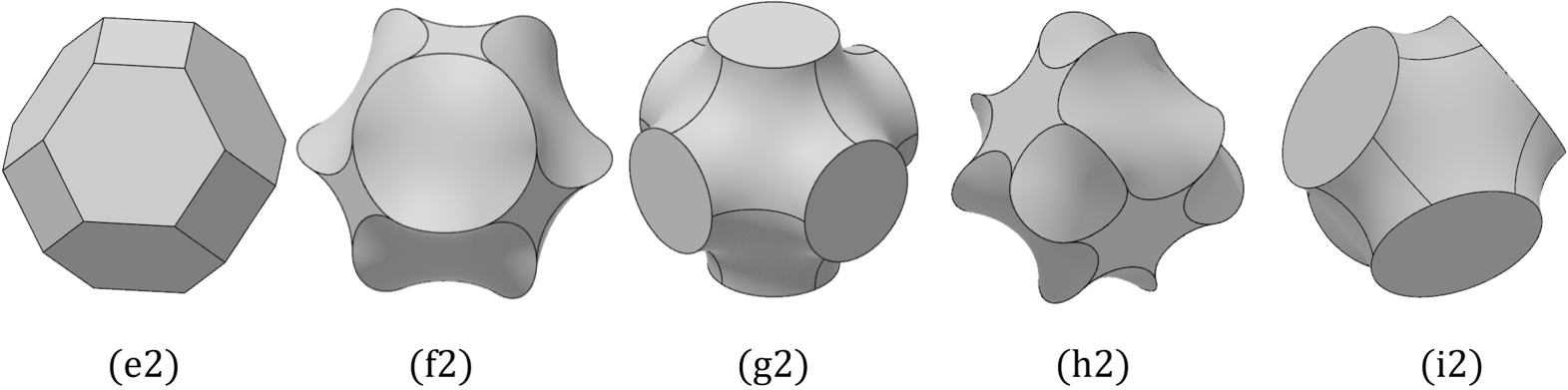
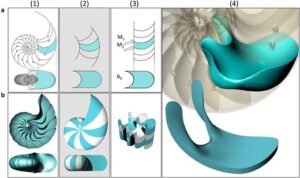
Soft cells and the geometry of seashells
Gábor Domokos, Alain Goriely, Ákos G. Horváth, Krisztina Regős.
Abstract: A central problem of geometry is the tiling of space with simple structures. The classical solutions, such as triangles, squares, and hexagons in the plane and cubes and other polyhedra in three-dimensional space are built with sharp corners and flat faces. However, many tilings in Nature are characterized by shapes with curved edges, nonflat faces, and few, if any, sharp corners. An important question is then to relate prototypical sharp tilings to softer natural shapes. Here, we solve this problem by introducing a new class of shapes, the soft cells, minimizing the number of sharp corners and filling space as soft tilings. We prove that an infinite class of polyhedral tilings can be smoothly deformed into soft tilings and we construct the soft versions of all Dirichlet–Voronoi cells associated with point lattices in two and three dimensions. Remarkably, these ideal soft shapes, born out of geometry, are found abundantly in nature, from cells to shells.

Gyula Strommer Scholarship for Gergő Almádi
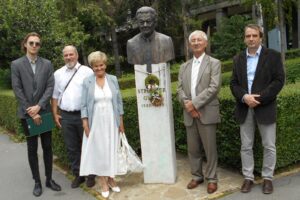
Gergő Almádi, member of our research group (to the left) won the Gyula Strommer Scholarship in 2024. The Scholarship is offered each year by the Gyula Strommer International Foundation of Geometry for one student of the BME. Congratulations!

Two lecturers in the top 100 of the BME
János Török and Krisztina Regős, members of our research group, are ranked 31st and 92th among all lecturers of the Budapest Univeristy of Technology and Economics.
Congratulations!
József Nádor Prize for Gergő Almádi
Gergő Almádi, student of the research group was awarded by József Nádor Prize on 12th March. The prize is traditionally given by the BME to students with outstanding candidature for the National Scholarship for Higher Education.
An interview with Krisztina Regős and Gergő Almádi at www.bme.hu
An interview with two young members of the HUN-REN Morphodynamics Research Group is published at www.bme.hu. Krisztina Regős and Gergő Almádi talk about the motivation of their research and experiences in publication.
Institutional Scientific Students’ Associations Conference 2023
At this year’s Institutional Scientific Students’ Associations Conference at the Budapest University of Technology and Economics, five presentations were related to Morphodynamics: Máté Szondi (1st Prize + Pro Progressio Special Prize), Gergő Almádi (1st Prize), Gergő Almádi and Eszter Ferencz (3rd Prize), Kinga Kocsis (Special award of the Department of Geometry and Morphology + Special award for presentation), Emese Sarolta Encz and Gergely Barta (Special award of the Department of Geometry and Morphology).
Continue Reading “Institutional Scientific Students’ Associations Conference 2023”
Klaudia Nagy awarded as the student of the year
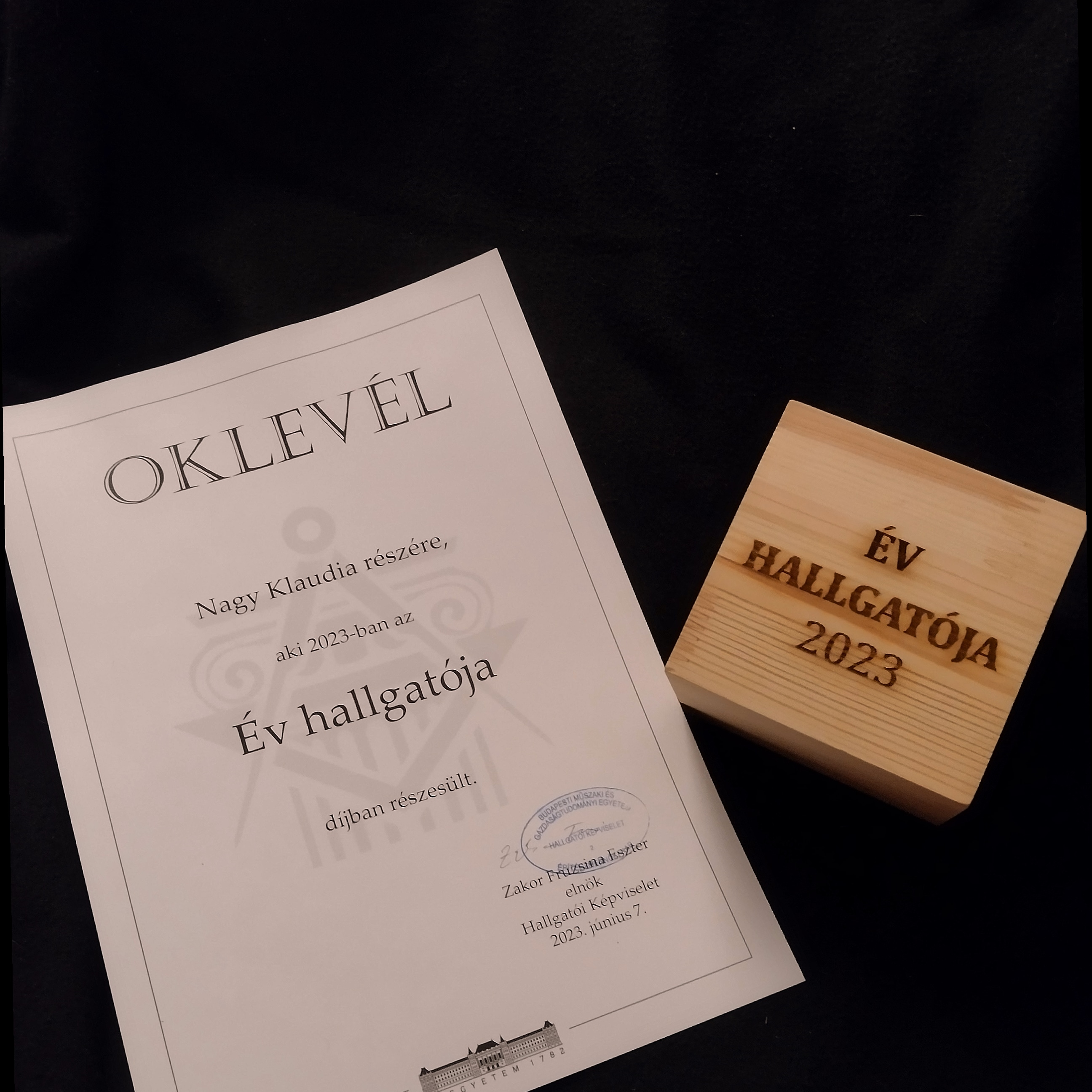
Klaudia Nagy, member of the Morphodynamics Research Group, has been awarded as “Student of the Year” at the Faculty of Architecture of BME. Congratulations!
Krisztina Regős in the “top 30 under 30” by Forbes.hu
Krisztina Regős, PhD student of the Morphodynamics Research Group was mentioned among the top 30 of most successful people under 30 in Hungary by Forbes.
Congratulations!
National Scientific Students’ Associations Conference 2023
Several presentations were held in the session for Mathematics, Physics and Geosciences of the 36th National Scientific Students’ Associations Conference in relation with the Morphodynamics Research Group. Gergő Almádi has been awarded by 3rd prize for his presentation entitled Inhomogén politópok mechanikai komplexitása – avagy van-e egy tetraédernek lelke?, under the supervision of Gábor Domokos and Krisztina Regős. Ágoston Szesztay (Iteratív módon csonkolt poliéderek statikai egyenúlyáról) and Máté Szondi (A kvantummechanikai állapottér egy felbontása által indukált geometria) got special prizes.
Continue Reading “National Scientific Students’ Associations Conference 2023”
Interview with Krisztina Regős at forbes.hu
An interview with Krisztina Regős, graduate student of the Faculty of Architecture of BME and her supervisor, Gábor Domokos has recently been published at forbes.hu.
The conversation reveals how Gömböc inspires young researchers, specifically how this discovery influenced Krisztina’s further research.
Institutional Scientific Students’ Associations Conference 2021
The Morphodynamics Group had a session titled ‘Geometry’ in the 2021 TDK Conference. Five students participated in the session and received numerous awards. Congratulations!
Krisztina Regős (1st Prize + Rector’s Award), Anna Viczián (1st Prize), Ágoston Szesztay (3rd Prize + Csonka Pál Special Prize), Klaudia Nagy (Department’s Special Prize), Máté Szondi (Metszet Journal Special Prize).
Continue Reading “Institutional Scientific Students’ Associations Conference 2021”
Institutional Scientific Students’ Associations Conference 2020
At this year’s Institutional Scientific Students’ Associations Conference at the Budapest University of Technology and Economics, 2 presentations were related to Morphodynamics: Ágoston Szesztay (1st Prize + Pro Progressio Special Prize), Klaudia Nagy (Csonka Pál Special Prize).
Continue Reading “Institutional Scientific Students’ Associations Conference 2020”
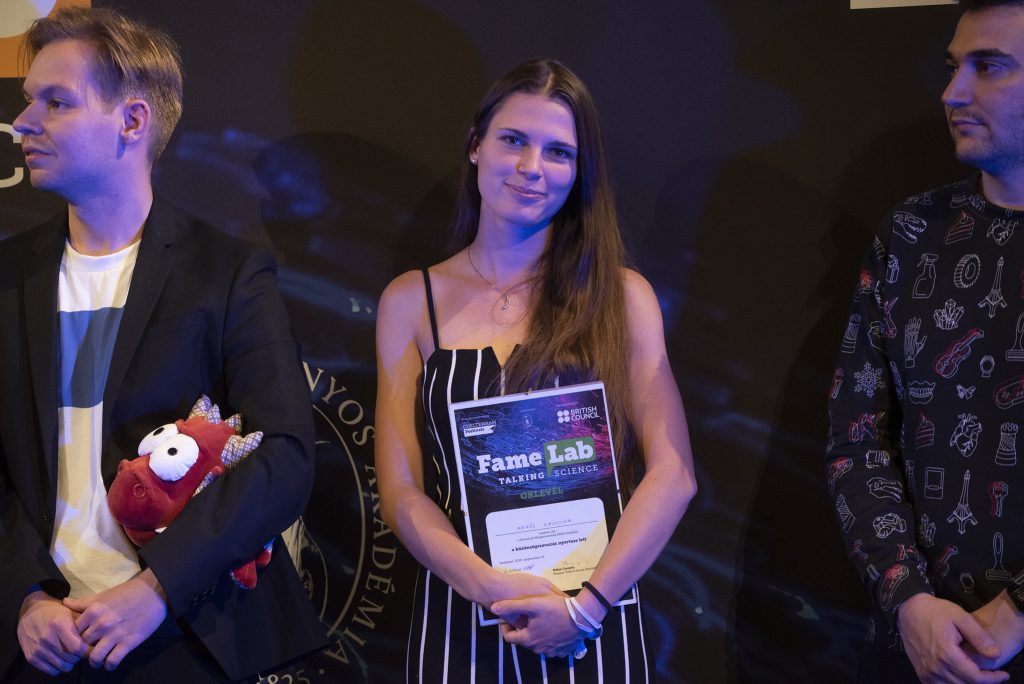
Krisztina Regős – Famelab 2020
Congratulations to Krisztina Regős, who won the audience favorite prize at Famelab 2020!
Article of the competiton by mta.hu
Article on bme.hu

photo: mta.hu / Tamás Szigeti
You can watch her talk here:
New paper on Balancing polyhedra
Balancing polyhedra
G. Domokos, F. Kovács, Z. Lángi, K. Regős and P.T. Varga, Balancing polyhedra, Ars Math. Contemp., accepted, arXiv:1810.05382 [math.MG]
Abstract: We define the mechanical complexity C(P) of a convex polyhedron P, interpreted as a homogeneous solid, as the difference between the total number of its faces, edges and vertices and the number of its static equilibria, and the mechanical complexity C(S,U) of primary equilibrium classes (S,U)E with S stable and U unstable equilibria as the infimum of the mechanical complexity of all polyhedra in that class. We prove that the mechanical complexity of a class (S,U)E with S,U>1 is the minimum of 2(f+v−S−U) over all polyhedral pairs (f,v), where a pair of integers is called a polyhedral pair if there is a convex polyhedron with f faces and v vertices. In particular, we prove that the mechanical complexity of a class (S,U)E is zero if, and only if there exists a convex polyhedron with S faces and U vertices. We also give asymptotically sharp bounds for the mechanical complexity of the monostatic classes (1,U)E and (S,1)E, and offer a complexity-dependent prize for the complexity of the Gömböc-class (1,1)E.
KOMAL article on convex polyhedra
Article appeared in the High School Mathematics and Physics Journal (KOMAL) with the title: Equilibria of convex polyhedra (in Hungarian).
Authors: Gábor Domokos, Flórián Kovács, Zsolt Lángi, Krisztina Regős, Péter Tamás Varga
Krisztina Regős is a finalist in FameLab 2020
Krisztina Regős is a finalist in the FameLab Hungary 2020. The national finals will be in the Fall of 2020.
BME- NEWS: „I started research with the support of an excellent group of professors”
National Scientific Conference Presentation Award 2019
Congratulations for Krisztina Regős on winning one of the four Presentation Awards on the National Scientific Student’s Conference 2019 with her presentation titled ‘Morphological analysis of fractured rock surfaces‘.
National Scientific Student’s Conference 2019
Results of the National Scientific Student’s Conference 2019:
Krisztina Regős Special prize
Péter Varga 2nd Prize
Congratulations to both of them!
Institutional Scientific Students’ Associations Conference 2018
At this year’s Institutional Scientific Students’ Associations Conference at the Budapest University of Technology and Economics, 3 presentations were related to Morphodynamics: Krisztina Regős (1st Prize + Pro Progressio Special Prize), Dániel Csallóközi (2nd Prize + Csonka Pál Special Prize), Péter Tamás Varga (3rd Prize).
Continue Reading “Institutional Scientific Students’ Associations Conference 2018”
Student Research Conference 2017
At this year’s Student Research Conference 4 presentations were related to Morphodynamics: Adria Kerekes & Dávid Büki (1st Prize), Dániel Csallóközi (2nd Prize), Julia Hegymegi (3rd Prize), Menyhért Gergye (3rd Prize + Best presentation award).
Continue Reading “Student Research Conference 2017”