By
By Soft cells, Kelvin foam and the minimal surfaces of Schwarz
Gábor Domokos; Alain Goriely; Ákos G. Horváth; & Krisztina Regős
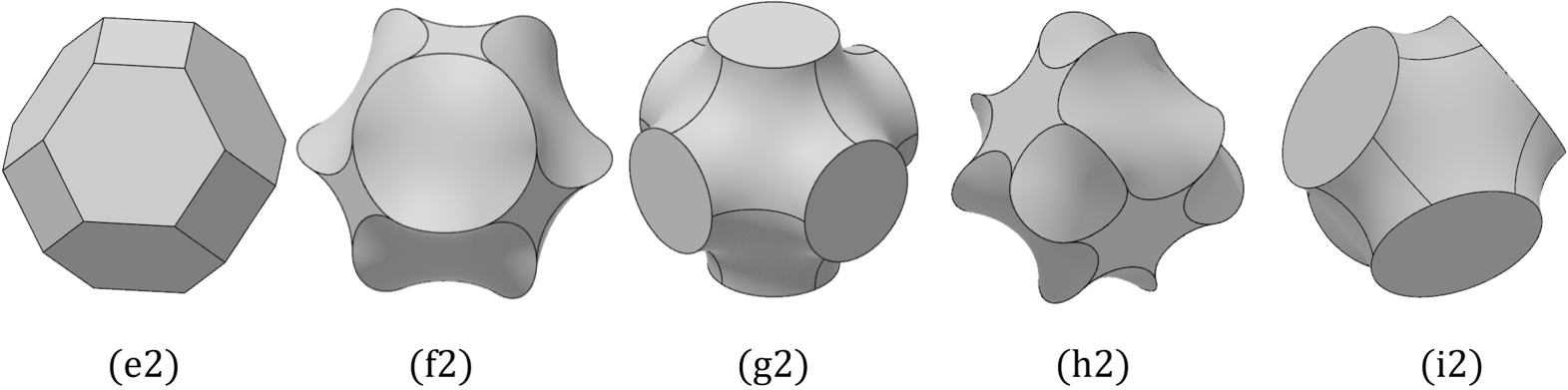
Abstract: We study a class of geometric shapes termed soft cells tiling three-dimensional (3D) space without sharp corners. A special class of soft tilings, called standard soft tilings, can be obtained by an algorithm transforming any convex polyhedral tiling into at least one combinatorially equivalent soft tiling. Natural examples of such shapes include, among others, cell tissues, corals and chambers in nautilus shells. However, this construction leads to sharp, highly curved edges. Here, we generalize this construction to produce not just a single standard soft tiling but all soft tilings corresponding to a given polyhedral configuration. Unlike standard soft cells, these non-standard soft cells do not exhibit protruding edges. Notably, some non-standard soft cells are the fundamental building blocks within triply periodic minimal surfaces (TPMSs) such as Schwarz surfaces and gyroid structures, which are critical in modelling the nanoscale architecture of various polymers and carbon-based materials. These shapes also appear at the nanoscale as fundamental models of biological structures. Finally, we identify a family of intermediate space-filling cells that bridge two distinct soft-cell morphologies, providing a previously unrecognized connection between Schwarz surfaces and encompassing the Kelvin cell, a structure of enduring importance in materials science.